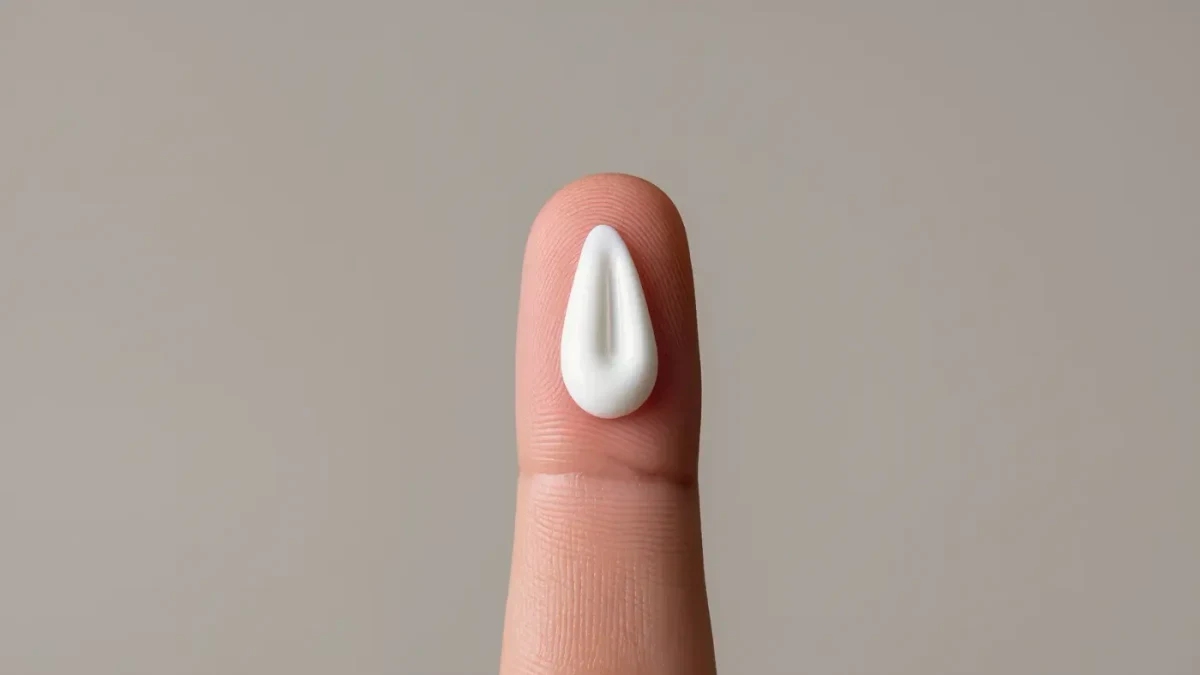
The working answer: a pea-sized amount for most leave-on face products, a two-fingertip length of sunscreen for the face and neck, and a coin-sized blob of cleanser — because the amount that feels like 'nothing' is usually the amount formulations are dosed for. The reference measure here is the fingertip unit, a dosing concept published by dermatologists Long and Finlay in the journal Clinical and Experimental Dermatology in 1991: one FTU is the squeeze from fingertip to the first crease, roughly half a gram, and it covers an area about the size of two adult palms. Once you count in these units, the 'is that enough?' question stops being a vibe.
Under-dosing wastes the product's reason to exist; over-dosing wastes money and sometimes adds pilling and sting. The middle path below covers every step in a normal routine. Standing note, as ever: this site publishes information, not medical advice.
How much cleanser is enough?
A coin-sized blob — roughly one fingertip unit for gel or cream formulas. Cleanser is a contact product: its job is surface removal, and twenty seconds of gentle massage does more than a second pump. Double cleansing splits the dose: a pea of cleansing oil or balm, then a half-dose of your regular gel. If your face feels squeaky afterward, the dose or the formula is too aggressive, not your diligence insufficient.
How much serum and moisturizer do actives need?
Serums: a pea, or about a quarter of a dropper for most pipette bottles. Actives like retinoids in particular are dosing-sensitive — published retinoid guidance consistently ties irritation to quantity as much as concentration, so a pea for the whole face is the instruction, not a suggestion. Moisturizer: one to two fingertip units, scaled up in winter or in dry climates and trimmed back in humid ones.
The counterintuitive part: more moisturizer does not add moisture. It adds occlusive duration. A thin layer reapplied beats a thick slab applied once, especially for skin that tightens by mid-afternoon.
How much sunscreen is actually required?
The number that shocks everyone: dermatology guidance, including the American Academy of Dermatology's public recommendations, calls for one full ounce — a shot-glass worth — for the adult body, and a two-finger-length line for face and neck. Most people apply a quarter to a half of tested amounts, which is why a 'SPF 50' used sparingly behaves like a lower factor in practice; studies on real-world application repeatedly find under-application as the norm. Reapplication every two hours of exposure doubles the dose problem — another reason sticks and powders exist.
If two full fingers of your current sunscreen sounds absurd, the fix is a formula you do not hate, not a smaller line.
Related stories: Niacinamide, explained: what it actually does · Do you need a toner, actually?.
Does more product mean faster results?
No, and with actives it means the opposite: more retinoid equals more irritation without more conversion, more acid equals more barrier stress, more vitamin C equals more expense. Absorption plateaus. The skin takes what it takes, and the surplus either sits on the surface, pills off, or irritates. The exception is occlusives and physical sunscreens, where coverage thickness genuinely is the mechanism — film integrity is dose-dependent.
Why do we over-apply some and under-apply others?
Pump engineering and marketing, mostly. Wide-nozzle pumps portion out more than a pea, so two pumps of a generous dispenser is double-dosing a serum that only needed one. Meanwhile sunscreen's dosing feels embarrassing — a two-finger line looks like a lot going on — so people self-ration an SPF that was already tested at full dose. The industry prices per milliliter but never prints the dose. Once you supply the dose yourself, a 30 ml serum lasting two months becomes one lasting four.
Quick answers
How long should a 30 ml serum last? At a pea per application, roughly 120 doses from a 30 ml bottle — about four months at once daily, two at twice daily. If yours vanishes in six weeks, the dose has crept; count pumps for a week and recalibrate. Dropper bottles are the worst offenders for silent over-dosing.
Is it bad to mix several serums in one dose? Mixing is chemically fine for most hydrators, but blending masks how much of each you are applying — the whole point of counting. Layer thin to thick in separate peas instead. Your face does not need six serums; if it has them, alternate mornings rather than stacking all doses daily.
Does body skin need the same dosing rules? No — body dosing runs larger by area. The fingertip-unit system from the 1991 paper was built for clinical dosing across body zones: one FTU per two palms of skin. Arms take about three units each, and a full adult body takes roughly thirty, which is how dermatologists get to that one-ounce figure for a full application.