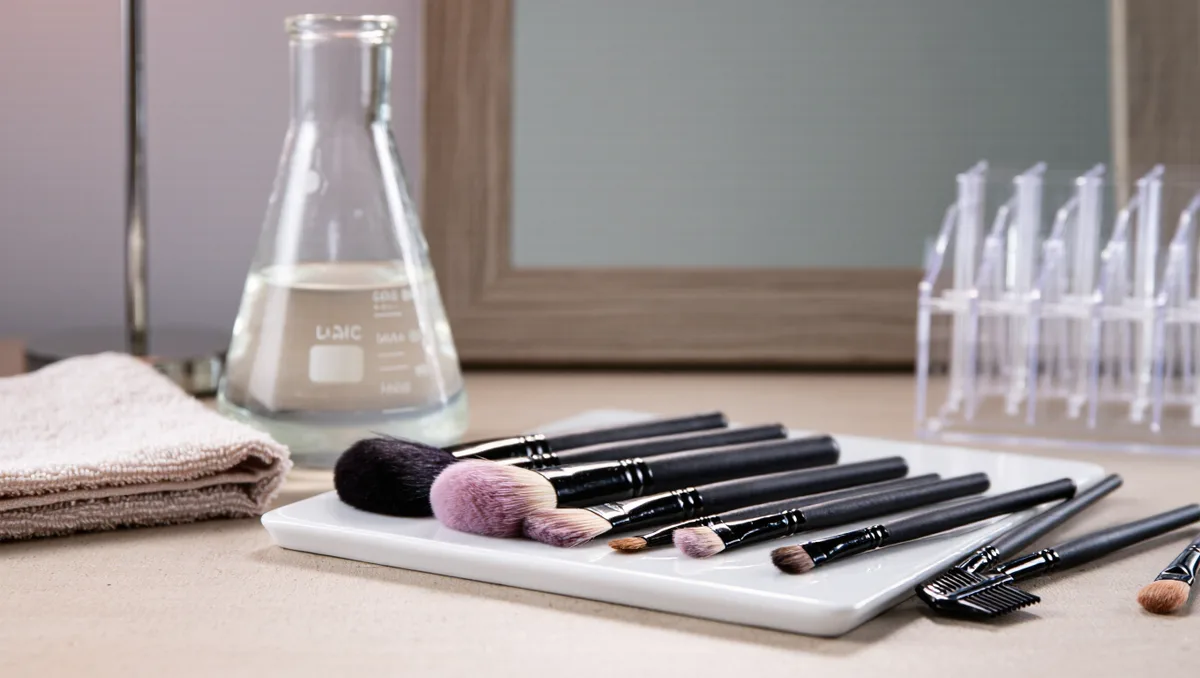
A dirty brush is the quiet saboteur of a good makeup routine. Product builds up between the bristles, the fibres stiffen, and whatever you paid for your foundation stops looking like the finish it was designed to give. Cleaning makeup brushes properly means removing that residue without soaking the ferrule — the metal band that glues the bristles to the handle — and letting them dry in a shape worth keeping.
How often? More often than most people manage, and less dramatically than the internet implies. A brush that touches liquid or cream product needs washing far more frequently than a powder brush, which can go longer between sessions. The honest answer is that frequency scales with what the brush touches: the wetter the product, the faster bacteria and buildup accumulate, and the sooner a wash is due. Anyone dealing with breakouts along the cheekbones or jaw has an extra reason to be diligent. This connects to our earlier piece, Chemical vs physical sunscreen: what the difference actually changes.
Beauty advice tends to skip this part, because it involves a sink and no purchase. But it is the cheapest upgrade in the routine. Here is how to do it well.
What should you actually wash a brush with?
You do not need a dedicated product, though they exist and some are lovely. A gentle soap or a mild shampoo does the job: brush bristles are hair, after all, and they respond to the same treatment your own hair would want. Work the soap into the bristles with your fingers or on the palm of your hand, or on a textured silicone pad if you own one, until the water running through runs clear.
What to avoid is just as important. Do not use anything harsh enough to strip the fibres, and never submerge the whole brush. Water that seeps into the ferrule dissolves the glue holding everything together, and a loose head is not a repairable situation. Keep the brush angled with the bristles pointing down or lying flat, water flowing out rather than in.
Cambridge's dictionary defines clean as, among other things, free from dirt or with nothing on it — which is the standard to hold a brush to. Not damp, not mostly rinsed, no film of product left in the dense centre of the bristles. That dense centre is where the residue hides, so press into it.
How often does each brush need it?
Think in categories rather than a single rule. Foundation brushes, concealers, sponges, and anything that touches the eye area sit at the demanding end: liquid and cream products cling, and anything used near the eyes deserves extra caution because that skin is sensitive. Powder brushes, blush, and bronzer tools are more forgiving, since dry powder leaves less behind and carries less risk.
A practical rhythm many makeup artists describe is a quick clean of the well-used face brushes on a short, regular cycle, with a full wash of the whole set less often. The exact interval matters less than consistency. If a brush starts to feel stiff, look discoloured, or smell faintly off, it has already told you it is overdue. Trust that signal over any schedule.
There is also the case of sharing. A brush that has touched someone else's face should be washed before it touches yours, full stop. This is one area where the rule is not negotiable, because the stakes are skin, not aesthetics.
How do you dry brushes without ruining them?
Drying is where good intentions go to die. The single worst move is standing a wet brush upright in a cup, bristles up: gravity pulls water down into the ferrule, and the glue loses the argument. The bristles also dry splayed, fanning out into a shape no one designed.
The right technique is unglamorous. After washing, squeeze the water out gently with a clean towel, reshaping the bristles with your fingers as you go. Then lay the brush flat on the edge of a counter or a table, with the head hanging slightly over the edge so air circulates around it. Some people prop the handle up on a folded towel so the head sits lower than the handle. Either way: flat, reshaped, and patient.
Give the brushes real time to dry — overnight at minimum, and denser brushes may need longer. A brush used damp is a brush that applies streaky and, worse, stays hospitable to bacteria. If your routine depends on a particular brush daily, owning a duplicate is a more sensible solution than rushing the drying.
Does any of this actually matter for your skin?
It does, and the reason is straightforward. Brushes pick up dead skin cells, oil, and product residue every time they touch your face. Left unwashed, they redeposit all of it the next morning, along with whatever has been growing on the bristles in the meantime. Dermatologists consistently flag shared or dirty makeup tools as a known contributor to irritation and breakouts, particularly for anyone already managing acne-prone skin.
The same logic applies to the rest of the routine. If you are paying attention to what goes on your skin, it is worth reading how the products themselves interact with it — our primer on chemical vs physical sunscreen covers one such distinction, and the skin barrier explainer covers why irritation is worth avoiding in the first place. Readers following this should also see What Is the Skin Barrier, Actually? A No-Nonsense Primer.
What this means for your routine
Our analysis, distilled: brush cleaning is a maintenance habit, not a beauty trend, and it behaves like one. It rewards consistency over intensity. A short, regular session for the brushes you use most, a deeper wash for the full set on a slower cycle, gentle soap, downward-rinsing, flat drying, and reshaping — that is the entire method, and it costs almost nothing.
The cultural irony is worth a smile. Beauty invests enormously in what goes onto the brush, and almost nothing in the brush itself. Yet the tool is the one piece of the routine that touches your face first, every single day. Treat it like the instrument it is. The bristles will hold their shape, the products will perform as intended, and your skin will quietly thank you for it.